

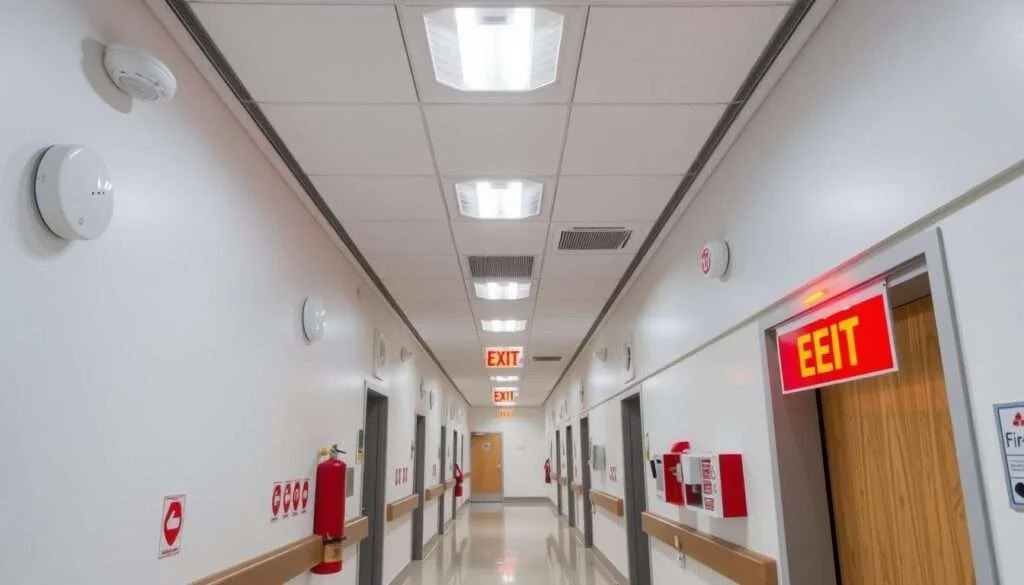
Fire watch duty and exit routes in healthcare buildings are governed by rules that are easy to misread. Hospitals, nursing homes, treatment centers, and residential institutions never fully empty, so they need clear patrol assignments and exit information that staff can act on at any hour. For administrators, wrong assumptions surface as failed surveys and funding exposure.
Myth: short outages don’t require a fire watch
A fire alarm control panel goes offline for repairs, and the assumption is that a few hours don’t count. Scheduled testing and maintenance that take a system out of service count as outages the same as failures do. NFPA 101 treats extended outages as impairments.
How long the outage lasts and which system is down determine what coverage the building needs. Local code and the facility’s own impairment policy set the requirements.
The facility’s impairment coordinator makes the call and starts the patrols. Every round goes into a fire watch logbook. Surveyors and fire marshals ask for that record before they ask anything else, and an outage with no logbook reads as an outage with no watch.
Hot work is the other common trigger. Maintenance that involves open flame generally needs a permit, and where the hazards, the permit or local rules call for one, a watch runs during the work and after it ends. The fire marshal can also order a watch on the spot during an inspection.
Myth: any available staff member can run the watch
A fire watch is a patrol, and the person doing it can have no other job. Codes require watch personnel to be dedicated to the patrol and trained to spot hazards. Training covers the building’s hazard areas and the procedure for raising an alert.
That rules out the charge nurse between rounds or the office manager covering a lunch break. Patient care interrupts by design, and an interrupted patrol leaves a gap in the record. Facilities that treat the watch as a side task tend to fail on both the patrol and the paperwork.
Myth: national codes are the whole rulebook
NFPA 101 is the baseline, and the Authority Having Jurisdiction builds on it. Local fire marshals enforce municipal amendments that are often stricter than the national text. Their interpretation decides what a compliant fire watch looks like in their city.
CMS and Joint Commission requirements add another layer. A facility can meet the national standard and still fail locally. Administrators need to research local practice before hiring, and pages such as fastfirewatchguards.com/illinois/chicago/ show how requirements read in a specific city. The next step is sharing the site’s own requirements with any candidate: system outage scope, log format, patrol frequency, and marshal contact. A provider who already knows those details shortens the conversation.
Myth: clear exits means clear exit doors
An egress path is the full route from any point in the building to the outside. Inspectors measure all of it. A facility can have every exit door unlocked and still fail a survey because of what sits in the corridors.
Storage rooms fill up, and the corridor becomes the overflow by default. The common items are operational: crash carts, workstations on wheels, laundry hampers, wheelchairs waiting for transport. Each one narrows the route that beds and stretchers would take during an evacuation. A cart parked at the wrong corner can block a turn that a bed needs to make.
Corridor storage is a frequent citation in healthcare surveys, and it is one of the easiest to prevent. Corridor checks need an assigned owner, the same as any other rounds.
Myth: a propped fire door is harmless
Passive fire protection works with no alarm and no human action. Fire-rated doors and smoke dampers divide a building into compartments. Those compartments are the evacuation plan in hospitals, where many patients can’t move quickly.
A door held open by a wedge or a linen cart removes the compartment. Smoke moves through the opening, and the corridor built to protect patients becomes the path the smoke takes. Approved hold-open devices release on alarm and let the door close; a wedge never does.
Fire doors carry self-closing hardware for this reason. Wedges show up during deliveries and equipment moves. The convenience lasts a few minutes, but the opening stays for hours.
The business case for getting it right
Fire watch and egress management are line items on the operations budget. A documented watch and a clear corridor protect accreditation and the funding the business depends on. Risk mitigation here costs little next to one structure fire or one lost survey.
The practical starting point is the impairment plan: who declares the watch, who patrols it, how often they round, and where the logbook lives. Those answers should be in place before the alarm panel goes offline.
Comments are closed.