

Many vibration motor failures are decided at purchase. The motor only does what its physics dictate, so the expensive mistakes happen when a spec sheet gets read through assumptions that do not hold. Plant managers and maintenance engineers inherit those decisions at the first failure. Each assumption survives because it sounds like savings at the quote stage, and each one costs the plant later.
Start with centrifugal force
The first number on a nameplate is power, but it is the wrong place to start. The work of moving bulk material is done by centrifugal force, the output of eccentric weights on the rotor shaft, rated in kilonewtons or kilogram-force. Wattage measures what the motor draws from the supply, while force measures what the hopper receives.
Speed comes from the pole configuration. A 2, 4, 6, or 8-pole winding design fixes the motor’s RPM and vibration frequency at a standard 50Hz or 60Hz supply, and the weight setting fixes the amplitude. A 2-pole motor runs fastest and suits fine material; an 8-pole runs slowest and suits heavy product. Supply frequency locks those speeds in, so pole choice is made at selection.
The myth that higher wattage means better flow pushes buyers toward oversizing. Two motors of identical wattage can deliver very different force at different frequencies, so wattage cannot be the comparison. An oversized motor draws more current every hour it runs and delivers more force than the structure was built to take. The extra purchase price is a one-time line. Energy waste and structural fatigue continue after installation, and they do not appear on any quote. Oversizing also hides the real diagnosis. If material will not flow, force at the wrong frequency is one thing to check alongside the material and the hopper itself, and added power leaves the frequency unchanged.
Frequency and amplitude solve different problems
Frequency is the speed of oscillation; amplitude is the distance of displacement. Pole count and supply frequency set the first, and eccentric weights set the second. Materials respond to the pairing, and getting one half wrong wastes the other.
Fine, dry powders need high frequency and low amplitude. The rapid oscillation fluidizes the powder, and it flows like a liquid. Large, heavy, or cohesive product needs low frequency and high amplitude, because the structure has to physically displace the mass. A motor specified for one job will underperform on the other, and no setting on the nameplate fixes that after installation.
Material bridging tests the pairing. Cohesive product forms an arch over the hopper outlet, and breaking that arch takes a precise force at a frequency the material responds to. The arch either breaks or holds, and the motor runs either way, drawing full current with zero flow. A variable frequency drive widens the options: it adjusts speed and force output by modulating the input frequency. Plants running one stable product can spec a fixed motor to the pairing. Plants running varied products get more from a VFD-equipped motor, at a higher purchase price and a lower cost per changeover.
A standard motor with offset weights stays a standard motor
The retrofit idea is understandable. A vibration motor looks like a standard motor with weights bolted on, and the standard motor is already on the shelf. What the shelf version lacks is everything inside the casting.
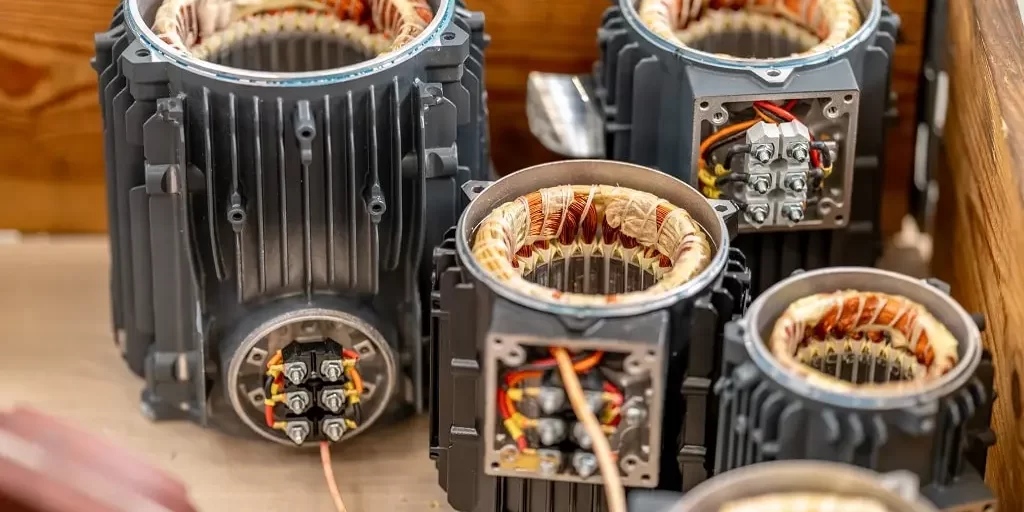
A general-purpose motor is built for belt or coupling loads along a predictable line. Its bearings are chosen for that load direction, and its shaft is chosen for that torque. The nameplate rating assumes that intended load. Run as a vibrator, the numbers stop describing the machine. Vibration loads act radially and continuously, in every direction of rotation, and each of those design choices becomes unsuitable. Purpose-built motors carry reinforced frames and heavier shafts, with bearings specified for the duty. A purpose-built electric vibration motor is engineered around continuous radial force from the casting outward, which is why the housing looks overbuilt next to a general-purpose unit.
Bearing life falls sharply as applied load rises, and the relationship is not linear. An underestimate of centrifugal force at selection can shorten bearing life well beyond what the sizing error suggests. On a retrofit, that error stays invisible at purchase. It surfaces later as a failed shaft and an unplanned stop, at a cost the cheaper motor was supposed to avoid.
The mounting structure is part of the machine
A vibration motor delivers force into whatever it is bolted to. If that structure flexes, it absorbs energy the material was supposed to receive. Weak or poorly reinforced mounting channels dampen the output: the motor draws full current while the hopper gets a fraction of the force. The power bill stays the same either way, but the flow does not.
The usual response to dampening is a bigger motor, which adds purchase cost and still loses force into the flex. A stiff mount lets a smaller motor do the work a larger one does on a weak mount. Bolt patterns and channel stiffness belong in the selection meeting.
Flexing structures also fatigue. Stress concentrates at welds and bolt holes, and the failure arrives as cracked channels or a cracked motor housing. Both get charged to the motor, even when the cause was the steel under it.
The harder limit is resonance. Every structure has a natural frequency, and a motor operating at that frequency drives amplitude upward until something gives. Selection has to account for the natural frequency of the hopper and the frame it sits on. That check is inexpensive at spec stage and expensive after a failure.
The environment inside a plant can be the harshest one
Dust gets inside buildings too, and indoor industrial plants are often harsher than outdoor sites. Rain is clean water at low pressure. A washdown routine delivers water and cleaning agents under pressure, aimed straight at the housing. Fine dusts like cement and silica are abrasive enough to work past seals that would stop rain, and flour behaves the same way in a food plant. IP66 and IP67 are not interchangeable approvals: IP66 covers high-pressure water jets, IP67 covers temporary immersion, and neither certifies a motor for every washdown routine. Use the rating on the specific product, matched to the exposure at the site. Ingress failure means a replacement motor at full price.
Stainless housings get treated as a sanitation extra, which undersells them. Grades 304 and 316 resist the chemical corrosion that attacks painted castings across food and chemical processing. Corrosion pits a housing surface, and pits give bacteria a place cleaning cannot reach. Cast stainless can also handle physical impact better than coated mild steel in tight processing zones.
Match the nameplate rating to the actual dust and cleaning routine on site. The stainless, high-IP premium is paid once, while the alternative is paid for each failure, with downtime in between.
Eccentric weights must stay symmetrical
The eccentric weights sit at both ends of the rotor shaft, and their setting determines amplitude. The setting must match on both sides. Unequal weights deflect the shaft with every rotation, and one bearing absorbs more of the load than the other. Wear concentrates on the loaded bearing, and the failure that follows can be quick.
The temptation is fine-tuning, trimming one side to hit a force between the published steps. The saving is a small adjustment, but the cost is the shaft and both bearings.
Weight changes belong to the manufacturer’s documented procedure, with both ends set identically. The published force figures assume symmetry. A motor running asymmetric weights is outside its rated condition, and its calculated L10 life no longer applies. The same logic covers any adjustment the documentation does not describe.
Single-phase and three-phase are different duties
Single-phase vibration motors have their place: lighter loads and sites without three-phase supply. The mistake is buying on phase count or price alone, because the nameplate duty rating, not the supply type, governs what the motor can sustain.
Three-phase power delivers high starting torque and balanced electrical loads, and three-phase motors shed heat better across long runs. Three-phase supply is the standard industrial electrical service for exactly this reason: it suits heavy, continuous duty. That is what S1 duty, continuous operation without overheating, demands in a heavy plant. An S3-rated motor is built for intermittent work with rest periods. Run it as S1 and the thermal margin is gone. Starting torque matters most at restart under load, when the motor has to break settled material loose.
The duty rating on the nameplate is the condition attached to the price. A cheaper S3 motor commits the plant to rest periods or early failure. Light, intermittent users get full value from single-phase and S3 equipment. Continuous plants pay for S1 whether they buy it or not.
Vibration motors need scheduled attention
A vibration motor shakes itself and everything it is bolted to. Fasteners loosen under that duty as a matter of physics. A mounting bolt that backs off changes the force path. A motor that detaches at full speed becomes a safety event and a structural repair at once.
The maintenance list is short: torque checks on mounting bolts, plus bearing temperature and current draw checked against the nameplate. Most plants already have the instruments, and the checks take minutes per motor. Rising temperature or current points to bearing wear while the bearing is still cheap to replace. Caught early, the fix is a planned bearing change on a scheduled stop. Missed, it becomes an unplanned stop with secondary damage priced in.
This does not need a large program. It needs a schedule and a record, so a rising trend gets seen before it becomes a failure. The labor cost of those checks is trivial next to one detached motor.
The pattern behind these assumptions is consistent: a lower number at purchase, a higher number in service. Selection by force, frequency, duty rating, and ingress protection costs less than selection by wattage and ticket price. The spec sheet already contains the figures, and the next purchase order is the place to read them in that order.