

Structural repair capacity is often limited by the number of suitable bays rather than the number of vehicles waiting outside. An extra long drive on bench can give a workshop more flexibility with extended vehicles, but the real productivity gain comes from planning how that equipment fits into the wider movement of work through the body shop.
A Bench Should Not Become A Parking Space
One of the biggest risks with structural work is allowing a difficult vehicle to occupy the repair bench while waiting for parts, authorisation or additional diagnosis. The bench may be technically in use, but no productive repair is happening.
Better planning starts before the vehicle reaches the bay. Dismantling should identify the damage properly, measurements should be planned, and required parts or fixtures should be known. If specialist equipment will be needed, it should be ready before the vehicle is loaded.
This matters even more with longer vehicles because moving them in and out can be less convenient. Every unnecessary repositioning takes time and may disrupt neighbouring work.
The aim should be to keep bench occupancy closely aligned with actual structural repair activity.
Drive-On Access Can Reduce Setup Friction
The easier a vehicle is to position, the faster technicians can begin meaningful work. Drive-on systems can simplify loading compared with arrangements that require more lifting or repositioning, particularly when dealing with longer vehicles.
That benefit depends on workshop layout. The approach to the bench needs enough clearance, and technicians should be able to access both sides once the vehicle is in place. If the bay is cramped, the theoretical convenience of drive-on loading can be lost.
Managers should consider the whole journey from workshop entrance to bench. How many turns are required? Does another vehicle need to be moved? Can a long van enter without blocking circulation? These practical questions have a direct effect on setup time.
A well-designed bay removes unnecessary steps before skilled repair work begins.
Tools And Accessories Need A Fixed Home
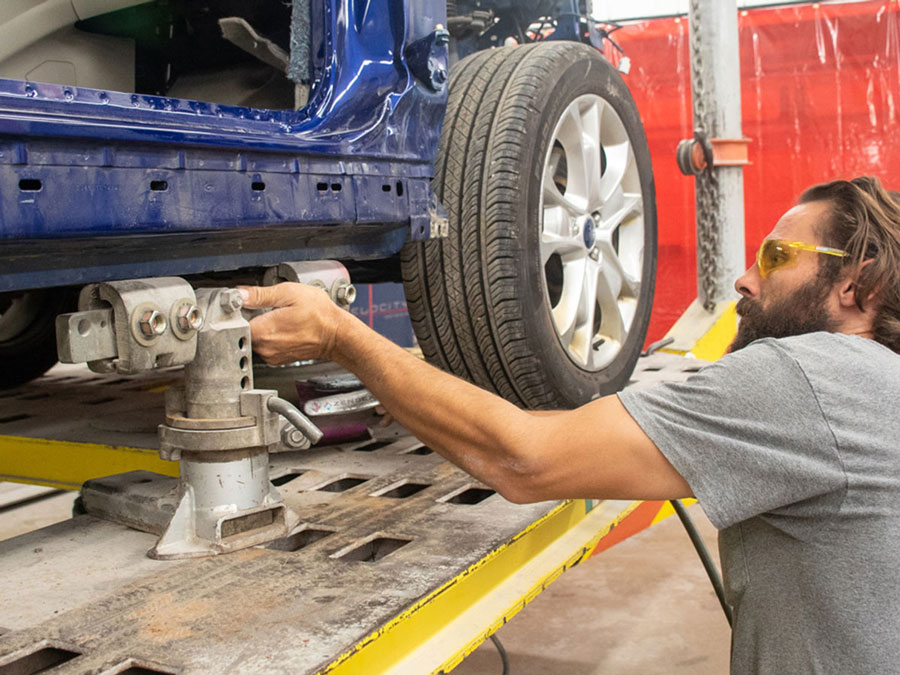
Structural repairs involve more than the bench itself. Clamps, chains, pulling equipment, measuring tools and fixtures all need to be available when required. If technicians spend time searching for accessories or moving them between distant storage areas, throughput suffers.
Organising equipment around the bay can make a noticeable difference. Frequently used items should be easy to identify and return to the same place after use. This reduces setup variation between technicians and makes it easier for another team member to understand the state of the job.
Good organisation also supports safety. Heavy or high-load equipment should be stored properly rather than left in walkways because there is no planned space for it.
Small workflow improvements become significant when repeated across many repairs.
Throughput Is About More Than Repair Speed
Managers often measure productivity through labour hours, but total vehicle time matters too. A structural technician may work efficiently while the vehicle still spends days waiting between stages.
Tracking those delays can reveal opportunities. How long does a vehicle wait for the bench? How long after straightening before it moves to the next department? Are vehicles being held for parts that could have been ordered earlier?
The value of a larger repair system is greatest when the rest of production is ready to support it. If downstream areas are already overloaded, increasing structural capacity simply moves the queue.
A productive repair bay combines suitable equipment with preparation, organised accessories and good scheduling. When those elements work together, the workshop can handle larger vehicles without allowing them to dominate valuable floor space.
Comments are closed.